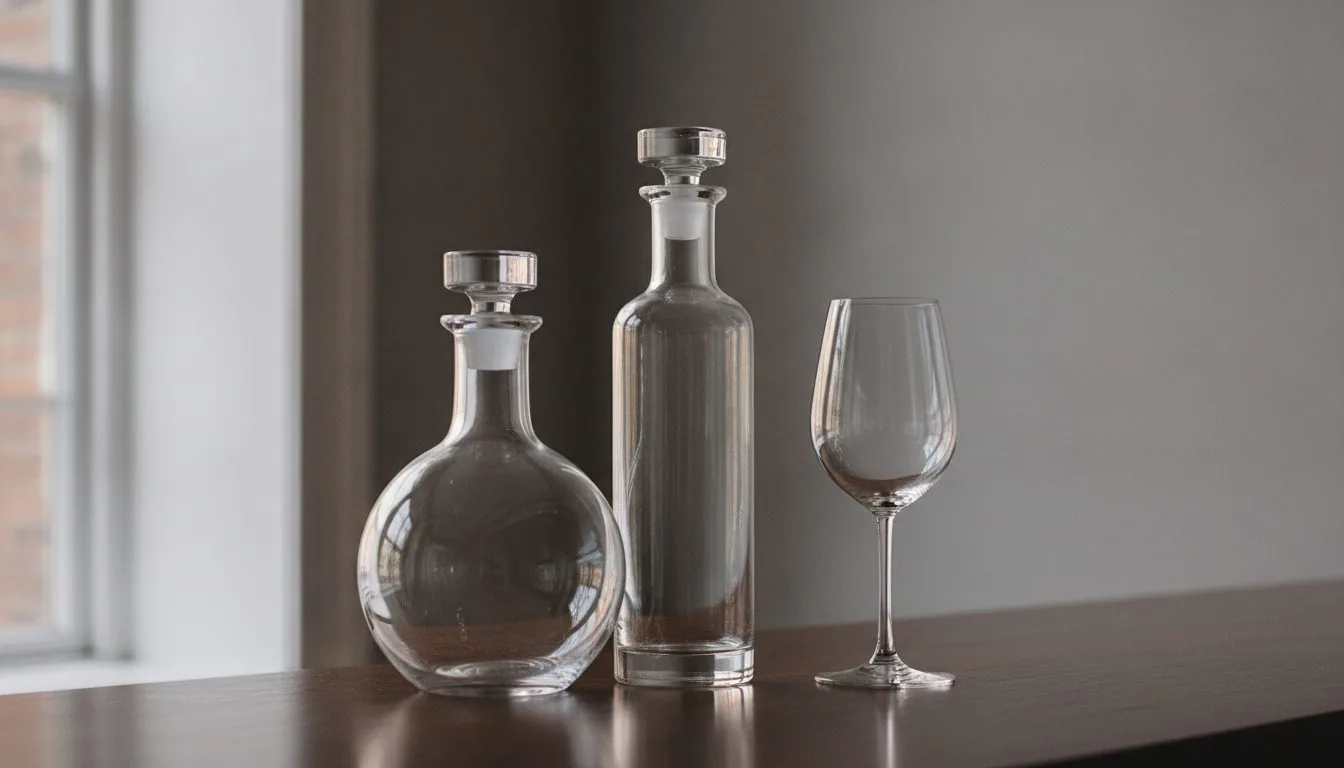
Quick Answer: A decanter is a vessel that lets wine sit and take in air. A wine aerator is a device that pushes air through wine as it is poured. Kendall-Jackson's 2014 article, which tried ten aerators, concludes that nothing aerates as well as a decanter plus enough time. It says cheaper aerators changed the wine only briefly, and that very old wines should not be aerated hard.
People search for the purpose of a wine aerator because the two tools are sold for the same job: letting a wine breathe. They go about it differently. This guide explains the difference, reports what one winery found when it tried ten aerators, and says when you need neither. For how long to leave wine in a decanter, see how long to decant wine. This guide does not review or rank any device.
What is the difference between a wine aerator and a decanter?
A decanter is a container. An aerator is a gadget. Kendall-Jackson's 2014 article (read October 2026) cites The Oxford Companion to Wine on the word "aeration": a deliberate, controlled exposure of a substance to air, and particularly to the oxygen in it. Kendall-Jackson says that makes "aerator" an imperfect name, since devices sold under it try to maximize the exposure, not control it. The same reference describes a decanter as a handleless clear glass bottle holding about a liter, and lists energetic agitation as a key idea in decanting.
What does an aerator do to wine?
It speeds up what a decanter does slowly. Kendall-Jackson explains why people let wine breathe: wine holds volatile aroma compounds that are released and evolve on contact with oxygen, and breathing can help harmonize the structure, particularly the tannins. St. Julian Winery gives a similar account of decanting in its page on when to decant (read October 2026), and says aeration softens tannins, especially in younger reds.
The article's author tried ten aerators with two or more wine styles each. Eight used the same young Cabernet Sauvignon and a Chianti Classico. The results varied. Several made little or no visible difference at first, and some effects showed only after 30 minutes or more in the glass. The article reports a clear split that largely depended on price: higher-priced devices changed aromas and textures in a way that lasted, and lower-priced ones gave only brief aromatic changes when the wine was first poured. All of them also toned down, if only for a while, the fresh fruit of a young, fruit-forward Cabernet Sauvignon.
Is a decanter better than an aerator?
On that trial, yes, with one exception. The article's conclusion is that nothing is as effective as a decanter with enough time, and it singles out one device as the exception. It adds that a decanter does not have to be fancy, because a water pitcher works, and that you can decant wine directly into a few wine glasses.
| Question | Aerator | Decanter |
|---|---|---|
| What it is | A device that exposes wine to air as you pour | A vessel the wine sits in |
| Speed | Quick, at the moment of pouring | Needs time, 20 minutes to 2 hours for reds per St. Julian |
| Effect in Kendall-Jackson's trial | Varied; lasting only in the higher-priced devices | Rated as the most effective with time |
| Sediment | Not discussed by either source | One of four reasons to decant, per St. Julian |
| Very old wine | Intense aeration can fade delicate aromas | Intense decanting can do the same |
Sources: Kendall-Jackson (2014) and St. Julian Winery, both wineries writing about their own experience.
When do you need neither?
Often. Kendall-Jackson says that the simpler and generally less expensive the wine, the less effect aeration has, and that many wines today are made to be drunk shortly after purchase. It says it is not shameful that plenty of wine does not need aeration. It cautions that very old wines, decades old, can lose their aromas if aerated too intensely. If a bottle is already open and you want to keep it, that is a different question: see how long red wine lasts after opening.
Which aerator should you buy?
This guide does not say. The only source read for aerator devices is a single 2014 article by one author, the devices it covers are the ones sold then, and naming or ranking them would repeat a dated trial as if it were current. If you want a gadget, the article's own advice is that most aerators make little difference after a few minutes in the glass. If you only want a wine to breathe, the article says a decanter, a water pitcher or a few wine glasses will do.
Does Esatto sell an aerator?
No. Pour and Seal makes pourers with lids, not wine accessories. Esatto makes and sells the plastic pourers in the Pour and Seal collection. They are our own products, not an independent pick, and they are plain pourers: nothing on their pages says they aerate wine, and we do not claim it. They are for liquor bottles. If you are looking for a tool that pours and closes a wine bottle, read the wine pourer stopper guide.
Frequently asked questions
What is the purpose of a wine aerator?
To expose wine to more air as it is poured, in the hope of releasing aromas and softening tannins faster than it would by sitting. Kendall-Jackson says the aim of devices sold as aerators is to maximize air and oxygen exposure.
Is a wine aerator better than a decanter?
In Kendall-Jackson's 2014 trial of ten, no. Its author concludes that nothing is as effective as a decanter and enough time, with one exception. That is one winery's view, not a laboratory result.
Do electric wine aerators work?
No source read for this guide covers electric aerators specifically, so this guide cannot say. Kendall-Jackson's article is from 2014 and was written about the devices on sale then. Its one finding on cost is that price largely split how long an aerator's effect lasted.
Do you need an aerator for cheap wine?
Kendall-Jackson says no. It says the simpler the wine, the less effect aeration has, and that a simple wine may be made for drinking soon after purchase.
Is there a wine aerator and stopper?
Kendall-Jackson's article mentions one aerator that doubles as a wine stopper. It reports no clear immediate effect, smoother tannins in the Cabernet after about 30 minutes, and no change in the Chianti Classico. Esatto sells neither an aerator nor a stopper.
Can you aerate an old wine?
Not hard. Kendall-Jackson says intense aeration or decanting of decades-old wines can make their delicate aromas change too fast and vanish from the glass.