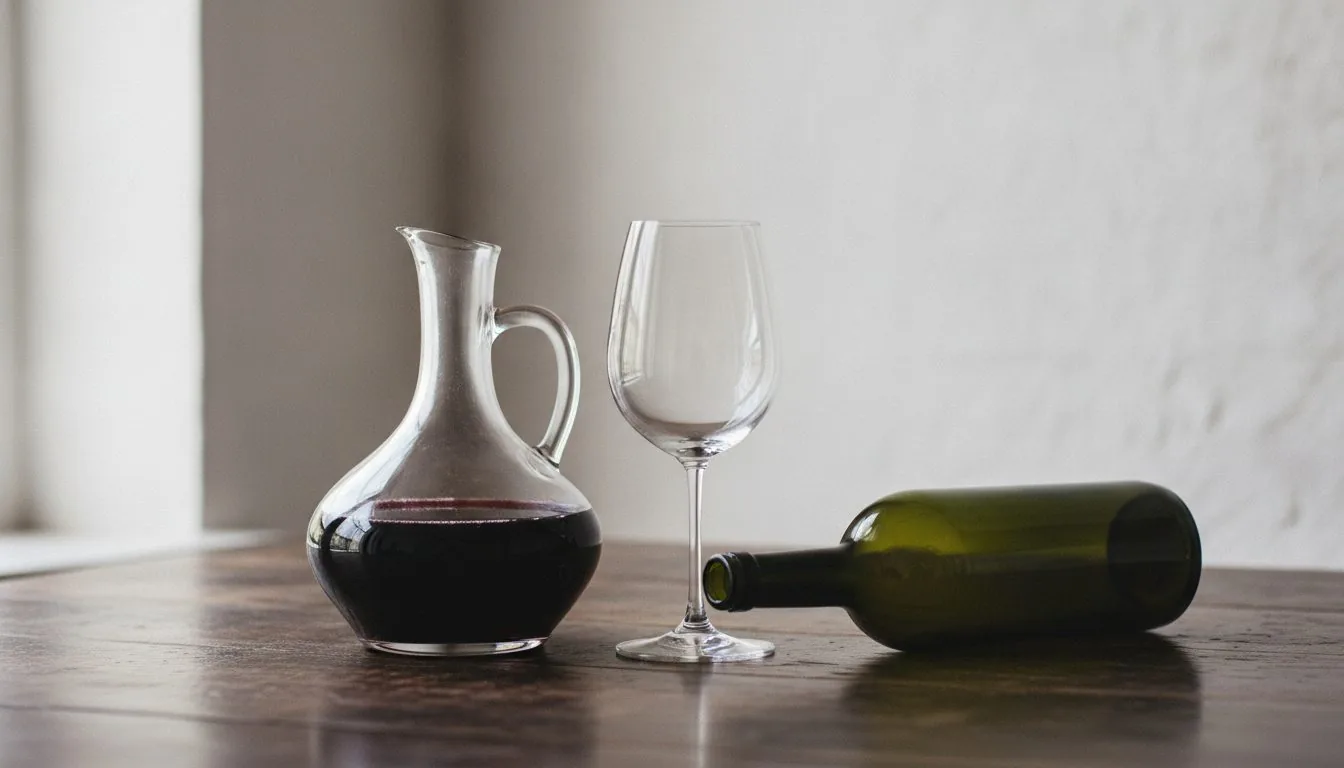
Quick Answer: St. Julian Winery says red wine typically benefits from 20 minutes to 2 hours of decanting: 20 to 30 minutes for light reds, 30 to 60 minutes for medium reds, and an hour or longer for full-bodied reds. It says most whites do not need decanting, and sparkling wines rarely do, never for more than 15 to 20 minutes. That is one winery's guidance, and another winery disagrees about white wine.
Decanting is simple to do and easy to overdo. This guide gives the time by wine style, the four reasons a winery gives for decanting, and the one point on which two wineries disagree. For a bottle you have already opened and want to keep, read how long red wine lasts after opening. Temperature matters alongside air, and it has its own page: wine serving temperature.
How long to decant wine, by style?
St. Julian Winery (undated page, read October 2026) answers by style. It is a winery writing about its own wines, so treat the times as its guidance rather than a rule.
| Wine style | Decanting time | Note from the source |
|---|---|---|
| Red wine, in general | 20 minutes to 2 hours | Younger reds benefit most |
| Light-bodied red | About 20 to 30 minutes | Pinot Noir is the winery's example |
| Medium-bodied red | 30 minutes to 1 hour | Merlot and Cabernet Franc are its examples |
| Full-bodied red | An hour or longer | Cabernet Sauvignon is its example |
| White and rosé | Only if there is reduction: then 15 to 20 minutes in the glass | Reduction means muted aromas or a burnt-match smell |
| Sparkling | Rarely, and no more than 15 to 20 minutes | Rare cases such as grower or small-production champagne |
The page gives no time for rosé on its own, only the shared white and rosé rule, so none is added here. It also gives no time for how long a red keeps after decanting.
Why do people decant wine?
St. Julian gives four reasons, and the first is air. Pouring wine from the bottle into a decanter exposes it to oxygen, which it says lets aromas open up and flavors come together. It says this especially benefits younger red wines, and that aeration softens tannins. The other three reasons are separating sediment, which it says can form as reds age and in some vintage ports, presentation, and helping wine reach its serving temperature, which helps if a bottle was stored too cool or too warm.
Do white and sparkling wines need decanting?
The two wineries read for this guide do not agree on white wine. St. Julian says most white wines do not benefit from decanting and that a Sauvignon Blanc can lose aromatics if left exposed too long. Kendall-Jackson (an August 2014 article, read October 2026) is about aeration more broadly. It says just about all wines benefit from oxygenation, even white wines.
| Question | St. Julian Winery | Kendall-Jackson (2014) |
|---|---|---|
| Do whites benefit from air? | Most do not; decant only for reduction | Just about all wines do, even whites |
| Very old wines | Not addressed | Do not aerate hard; delicate aromas can fade quickly |
| Sparkling | Rarely; 15 to 20 minutes at most | Not addressed |
Their scope is not identical. One is a short how-to on decanting, the other a longer piece on aeration devices. If you follow the narrower rule, pour a white straight from the bottle and give it 15 to 20 minutes in the glass only if the aromas are muted or smell like a burnt match.
When should you not give wine much air?
With very old wine. Kendall-Jackson says the aromas of decades-old wines are delicate and that intense aeration or decanting can make them change too quickly and vanish from the glass. St. Julian's warning is about whites: a Sauvignon Blanc can lose aromatics if left exposed too long. Neither source covers keeping a decanted wine for later.
Does Esatto sell a decanter?
No. Pour and Seal makes pourers with lids, not wine accessories, so Esatto sells no decanters, funnels or aerators. Esatto makes and sells the plastic pourers in the Pour and Seal collection. They are our own products, not an independent pick. A lidded pourer is for pouring from a liquor bottle. It is not a decanter and it is not a wine stopper; for stoppers, see the wine pourer stopper guide.
Frequently asked questions
How long should red wine breathe?
St. Julian Winery gives 20 minutes to 2 hours for red wine, shorter for light reds and longer for full-bodied ones. Its page says the answer depends on the wine style, and that younger reds benefit most.
How long to decant red wine?
Light-bodied reds about 20 to 30 minutes, medium-bodied reds 30 minutes to an hour, and full-bodied reds an hour or longer, according to St. Julian. Those are the winery's times for its own wines.
What is the purpose of a wine decanter?
St. Julian lists four: aerating the wine, separating sediment, presentation, and helping the wine reach its ideal serving temperature. Sediment forms as reds age and in some vintage ports.
Do you decant white wine?
Rarely, according to St. Julian, and only if reduction shows as muted aromas or a burnt-match smell. Then it suggests pouring into a glass and waiting 15 to 20 minutes. Kendall-Jackson takes a wider view of air for whites.
Should you decant sparkling wine?
St. Julian says sparkling wines rarely need it. In rare cases, such as small-production champagnes, a brief decant can reduce sulfur notes, and it limits that to 15 to 20 minutes.
Do you need a fancy decanter?
No. Kendall-Jackson says a decanter does not have to be fancy and that a water pitcher works. It also says you can decant a wine directly into a few wine glasses.