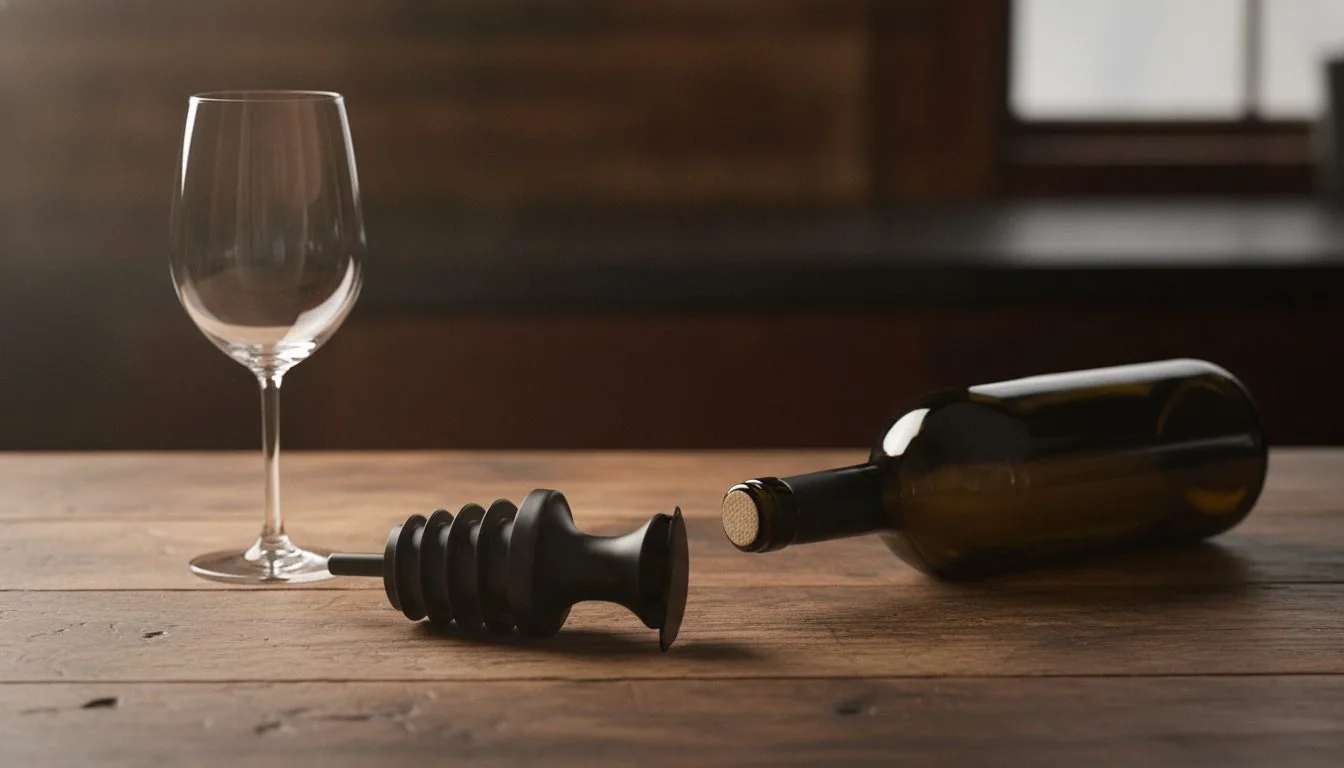
Quick Answer: A wine pourer stopper is one tool that sits in the bottle neck to pour and to close. No source checked gives a keeping time for one, and Esatto does not sell one. Kendall-Jackson's advice for any closure is a tight seal, the fridge and as little air as possible, and its ranges for recorked still wine run from 1 to 5 days for most styles. Esatto's lidded pourer is for liquor bottles and makes no wine claim.
If you want one tool that pours and closes a wine bottle, the question is whether it seals as well as a plain stopper. This post takes that question with the evidence there is: what the wineries say about closing a bottle, what a pourer-stopper would need to do, and why a lidded pourer is a bar-bottle tool, not a wine one. The vacuum option is in the vacuum wine stoppers post, the sparkling case in the sparkling wine stoppers post, and the comparison of built-in lids and loose caps in the liquor pourers with caps post.
What is a wine pourer stopper?
It is a combined pourer and closure for a wine bottle. People search for it as a wine pourer spout, a wine bottle pourer, a wine bottle pourer and stopper or a bottle pourer stopper. None of the winery pages checked for this post describes that type of product, so there is no winery guidance on it, and this post does not invent any.
How long does wine keep with one?
No source gives a figure for a pourer-stopper. The closure matters less than the wine and the conditions. Kendall-Jackson gives 1 to 3 days for lighter reds, 4 to 5 for full-bodied reds, 2 to 3 for full-bodied whites and 3 to 5 for lighter whites. It says keeping open wine fresh means reducing oxygen exposure and slowing oxidation, that opened whites, rosés and reds belong in the fridge, and that a proper stopper gives a tight seal. Its preserver review adds that ideally there is no airspace between the wine and the stopper.
| What to check | Why, according to Kendall-Jackson |
|---|---|
| Does it close the opening fully? | Reducing oxygen exposure is the point; improper sealing means more oxygen and cancels the benefit |
| Does it fit the neck? | Bottle necks are not all the same size, which is why it suggests spare corks of different widths |
| Is the bottle in the fridge? | Cold significantly delays oxidation, though an open bottle keeps changing |
| Is it still wine? | Not sparkling: a regular stopper can be pushed out by the pressure |
Does a pourer stopper stop drips?
No source checked says so for wine. Drip claims appear on product pages, and they should be read as the seller's, not a test. Esatto's stainless liquor pourers carry "Drip-Free" in their names and their copy describes an anti-drip airflow design. That copy is about liquor bottles and makes no claim about wine, so this post makes none.
When is a lidded pourer the better tool?
For a bar bottle you pour from often. A lid or cap on a pourer closes the pouring opening between pours, and the bottle sealers guide sets out the closures. For wine, the sources recommend a stopper, a cork or a pump and the fridge. For a pourer with a separate cap instead of a lid, see the flip-lid versus dust cap guide on pourspoutcover.com.
When is a pourer stopper the wrong choice?
For sparkling wine, and for any wine you want to keep longer than a few days. Kendall-Jackson says a regular cork or wine stopper can eject from a sparkling bottle, and recommends a stopper with arms. For still wine you want to keep longer, Kendall-Jackson suggests a pump, an inert gas spray or a half bottle. It says pouring the remainder into a 375 ml half bottle, filled to the top, leaves little area at the neck for air.
Where the Esatto Plastic Pourer With Lid, Pack Of 12 Pieces, Black fits
Esatto makes and sells the Plastic Pourer With Lid, Pack Of 12 Pieces, Black. It is our own product, not an independent pick. It is a pourer with a built-in lid for liquor bottles, and the page says the lid lets you seal the bottle easily. It is not a wine pourer stopper and not a wine stopper: its page says nothing about wine, and Esatto sells no wine stoppers. If your open bottle is wine, close it with a stopper or cork and refrigerate it. See also the Pour & Seal collection and Other Esatto Pourers.
Frequently asked questions
What is a wine pourer stopper?
A single tool meant to pour wine and close the bottle. No winery page checked describes the product, so there is no winery guidance on how long wine keeps with one.
Do I need a wine pourer spout?
Not to keep wine. Kendall-Jackson says to recork promptly, refrigerate, and use a proper stopper or pump if you want a tight seal. A wine pourer spout is about pouring. Whether it also seals depends on the product.
Does a wine bottle pourer keep wine fresh?
Only if it closes the bottle. A pourer that leaves the opening uncovered does nothing for oxygen exposure, which Kendall-Jackson calls the thing to reduce. Check that the product is sold as a closure.
Is there a wine bottle pourer and stopper that works?
No source checked tests one, so there is no evidence either way. Kendall-Jackson's informal trial covered a hand pump and other preservation devices, not pourer-stoppers.
Can a bottle pourer stopper be used on sparkling wine?
Not if it is a regular stopper. Kendall-Jackson says a regular stopper can be pushed out by the pressure and cause injury. Use a stopper with arms or a clasp, made for sparkling wine.
Is the Esatto lidded pourer a wine stopper?
No. The Plastic Pourer With Lid is a pourer with a built-in lid, written up for liquor bottles. Esatto sells no wine stoppers or vacuum pumps.
Can I leave a pourer in a wine bottle?
No source checked says it keeps wine. Kendall-Jackson says to recork promptly and refrigerate. If the pourer closes the opening tightly, that helps with air, but check the product for that claim.